

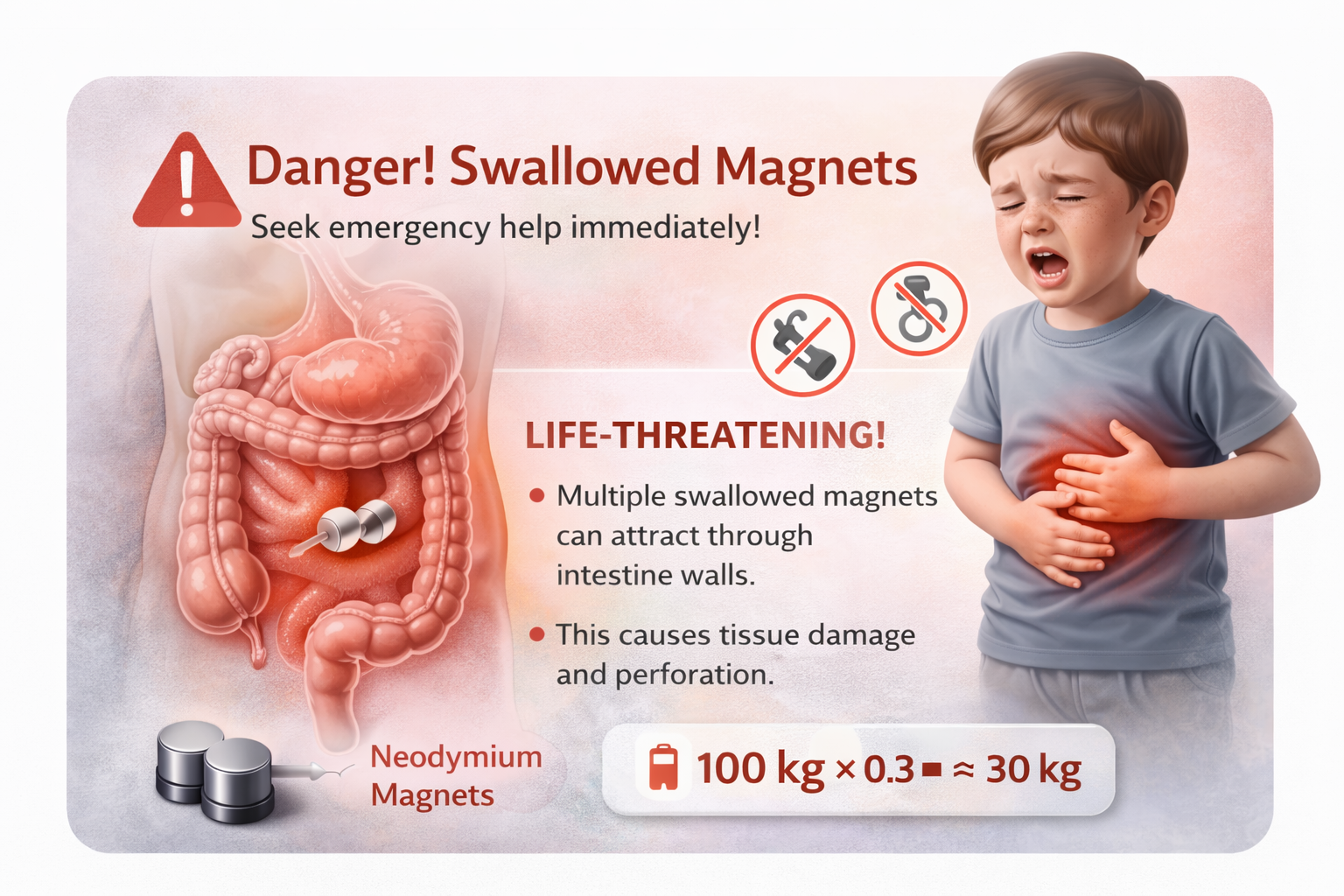
Why neodymium magnets are dangerous for children
Neodymium magnets:
-
are much stronger than ordinary magnets,
-
attract violently,
-
are often small and easy to swallow.
This combination makes them extremely hazardous.
Main risks
1. Swallowing multiple magnets (most dangerous)
If two or more magnets are swallowed:
-
they attract through intestinal walls,
-
trap tissue between them,
-
cause necrosis and perforation.
This often requires emergency surgery.
2. Finger and skin injuries
Strong magnets can:
-
snap together suddenly,
-
pinch skin or fingers,
-
cause bruises or cuts.
3. Eye injuries
Flying magnets or chipped coatings can cause:
-
eye trauma,
-
permanent vision damage.
4. Interference with medical devices
Strong magnetic fields may interfere with:
-
pacemakers,
-
hearing aids,
-
medical implants.
Are there safe magnets for children?
Yes – but not neodymium magnets.
Safer options include:
-
ferrite magnets,
-
large certified educational magnets,
-
toys with CE / EN 71 certification.
Risk level table
| Magnet type | Risk for children |
|---|---|
| Large ferrite magnet | low |
| Certified toy magnet | low |
| Small neodymium magnet | very high |
| Neodymium magnetic balls | extreme |
Safe storage rules
-
keep magnets locked away,
-
never leave loose magnets accessible,
-
avoid using them in children’s projects.
What to do if a child swallows a magnet?
Seek medical help immediately.
Swallowing multiple magnets is a medical emergency.
FAQ
Can neodymium magnets be toys?
No. They are not toy-safe and violate safety standards.
Is one swallowed magnet dangerous?
Less dangerous, but still requires medical consultation.
Are magnetic balls dangerous?
Yes – among the most dangerous magnet products.