

Why rated force is not real force
Rated force is measured:
-
under laboratory conditions,
-
on thick, flat steel,
-
with vertical pull-off,
-
without vibration or side load.
It represents the maximum possible value, not everyday performance.
Step 1: Start with rated force
Check:
-
rated pull force (e.g. 100 kg),
-
magnet type (bare or housed),
-
magnet grade.
This is your baseline value.
Step 2: Define working conditions
Ask:
-
vertical pull or shear force?
-
surface condition (paint, rust, uneven)?
-
steel thickness?
-
operating temperature?
-
vibration or movement?
Each factor reduces effective force.
Step 3: Apply correction factors
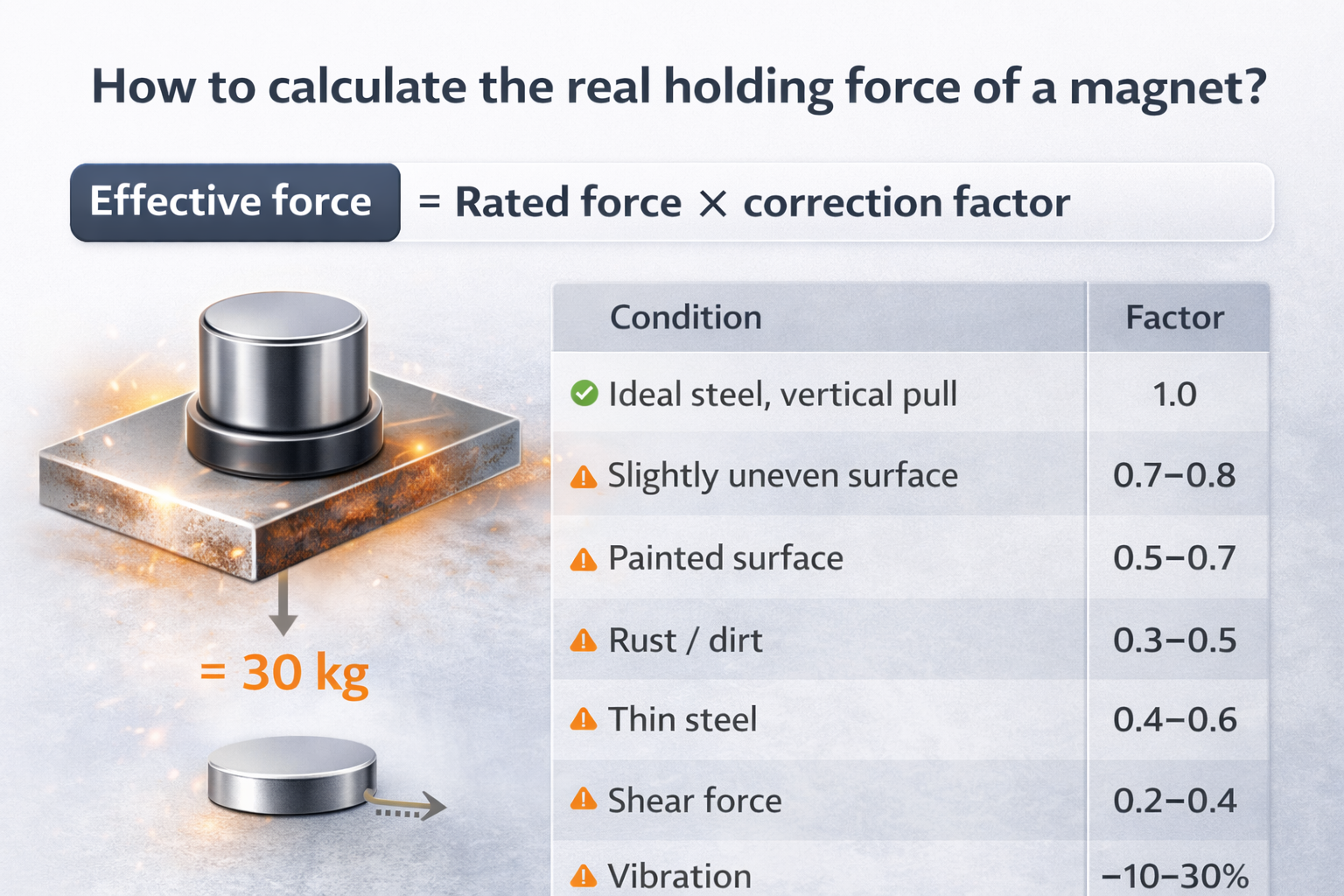
| Condition | Factor |
|---|---|
| Ideal steel, vertical pull | 1.0 |
| Slightly uneven surface | 0.7–0.8 |
| Painted surface | 0.5–0.7 |
| Rust / dirt | 0.3–0.5 |
| Thin steel | 0.4–0.6 |
| Shear force | 0.2–0.4 |
| Vibration | −10–30% |
Step 4: Practical formula
Effective force = Rated force × correction factor
Example:
100 kg magnet on painted surface with shear load:
-
factor ≈ 0.3
-
effective force ≈ 30 kg
Step 5: Always add a safety margin
In real use:
-
apply 2–3× safety margin,
-
especially for dynamic loads.
What increases effective holding force?
-
steel housing,
-
smooth, clean contact surface,
-
vertical pull direction,
-
lower operating temperature.
Common calculation mistakes
-
trusting rated force blindly,
-
ignoring shear force,
-
no safety margin,
-
confusing magnet grade with holding force.
FAQ
Can holding force be calculated exactly?
No, but it can be estimated very accurately.
Do identical magnets always hold the same?
No – surface and conditions matter.
Does a steel housing really help?
Yes – often more than increasing magnet size.