

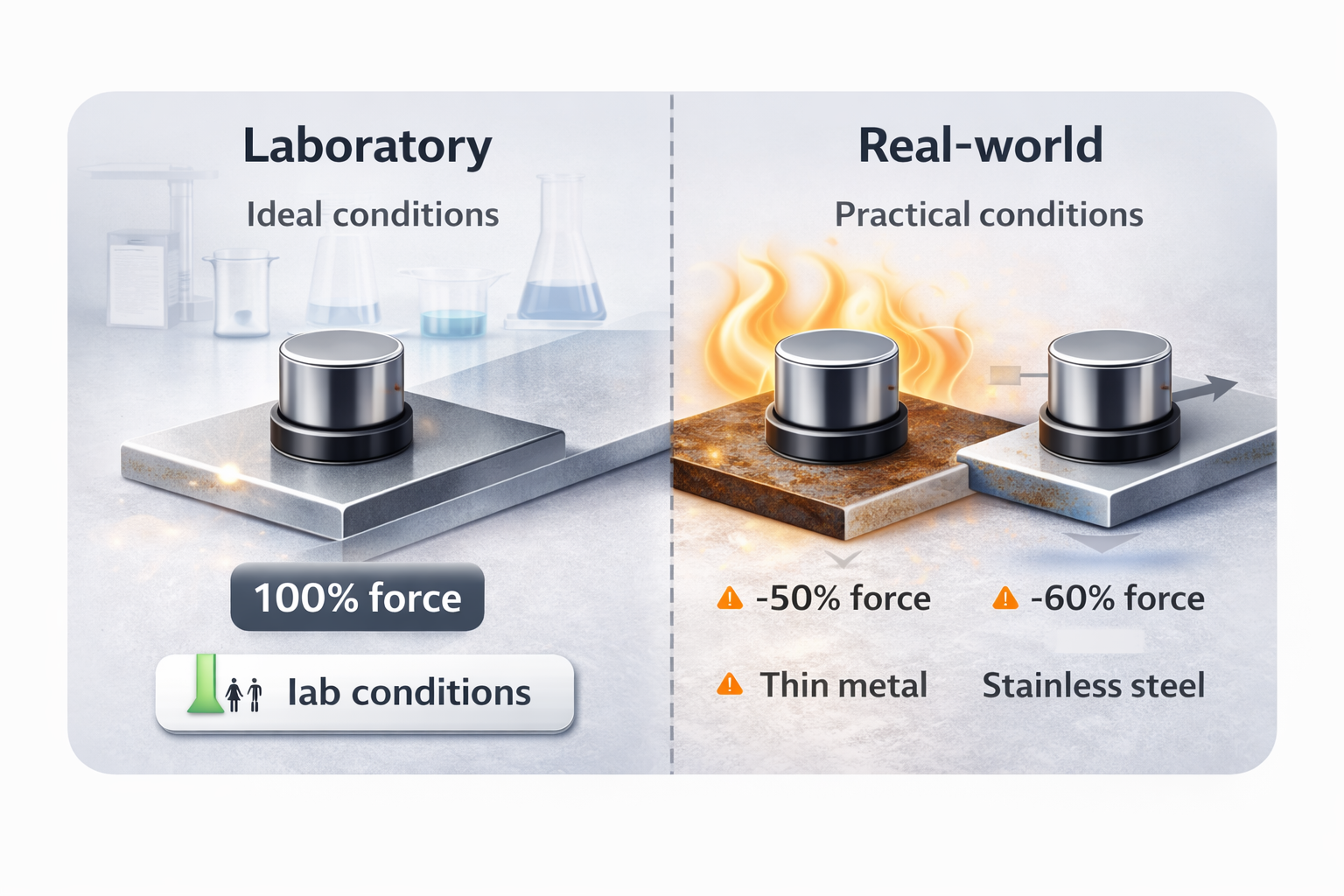
What does “rated pulling force” actually mean?
Rated force is measured:
-
on thick, flat, clean steel,
-
with full surface contact,
-
during vertical pull-off,
-
under laboratory conditions.
It represents maximum possible force, not everyday performance.
Common reasons magnets feel weaker in practice
1. Surface conditions
Magnets perform best on clean, thick steel.
Paint, rust, thin metal, or stainless steel reduce effectiveness.
2. Shear force instead of vertical pull
Rated force assumes vertical pull.
Sliding or sideways force can reduce holding strength dramatically.
3. No steel housing
Bare magnets lose part of their magnetic field.
Steel housings concentrate the field and improve real holding force.
4. No safety margin
Choosing a magnet rated exactly for the load is a common mistake.
A 2–3× safety margin is recommended.
5. Temperature effects
Standard neodymium magnets lose strength above ~80°C.
Overheating may cause permanent demagnetization.
Practical comparison table
| Condition | Effective force |
|---|---|
| Ideal lab surface | 100% |
| Painted surface | 60–80% |
| Thin metal | 40–60% |
| Rust / uneven | 30–50% |
| Shear force | up to −70% |
Is the product description misleading?
No.
It states the maximum tested value, not a guarantee for all conditions. The misunderstanding comes from how magnetic force works in real applications.
How to choose a magnet that really holds?
-
choose higher rated force than required,
-
use steel-housed magnets when possible,
-
consider surface type and direction of force,
-
account for temperature and vibration.
FAQ
Can a magnet suddenly lose grip?
Yes, especially under shear force or vibration.
Does paint really reduce holding force that much?
Yes. Even thin coatings create an air gap.
Is a bigger magnet always the solution?
Not necessarily — design often matters more than size.