

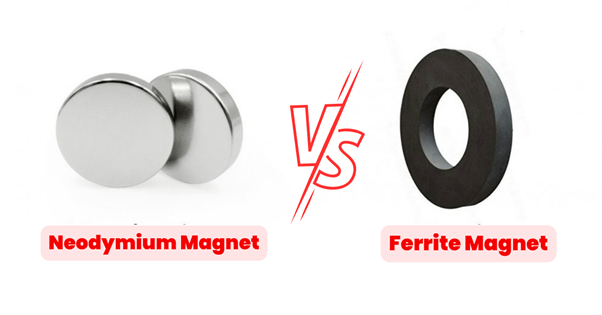
Why size alone does not determine magnet strength
Magnet performance depends on:
-
magnet grade (e.g. N42, N52),
-
magnetic field concentration,
-
contact surface quality,
-
air gap,
-
use of a steel housing.
Size alone does not guarantee strong holding force.
Practical example: small vs large magnet
-
Small N52 neodymium magnet
-
very high magnetic energy density,
-
strong magnetic field in a compact size.
-
-
Large ferrite magnet
-
much weaker magnetic field,
-
larger size but lower holding force.
-
➡️ Result: smaller can be stronger.
What really increases magnet strength?
1. Magnet grade
Higher grades provide:
-
stronger magnetic fields,
-
higher holding force at the same size.
2. Steel housing
A steel cup or housing:
-
concentrates the magnetic field,
-
reduces energy loss,
-
significantly increases effective holding force.
3. Contact surface
Magnets perform best on:
-
thick, flat steel,
-
clean, uncoated surfaces.
Paint, rust, or thin metal reduce strength.
Comparison table
| Feature | Small neodymium magnet | Large weaker magnet |
|---|---|---|
| Size | small | large |
| Material grade | high | low |
| Holding force | high | low / medium |
| Efficiency | very high | low |
When is a bigger magnet actually stronger?
A bigger magnet will be stronger if:
-
it is made of the same material,
-
it has the same grade,
-
it works under identical conditions.
Only then does size directly correlate with strength.
Common mistakes
-
judging strength by size alone,
-
comparing different magnet materials,
-
ignoring housing and air gap effects,
-
choosing the largest magnet instead of the right one.
FAQ
Does a bigger magnet always hold more weight?
No. Material and design matter more than size.
Can a small magnet be very strong?
Yes, especially high-grade neodymium magnets.
Does a steel housing increase magnet strength?
Yes. A properly designed housing significantly improves effective holding force.