

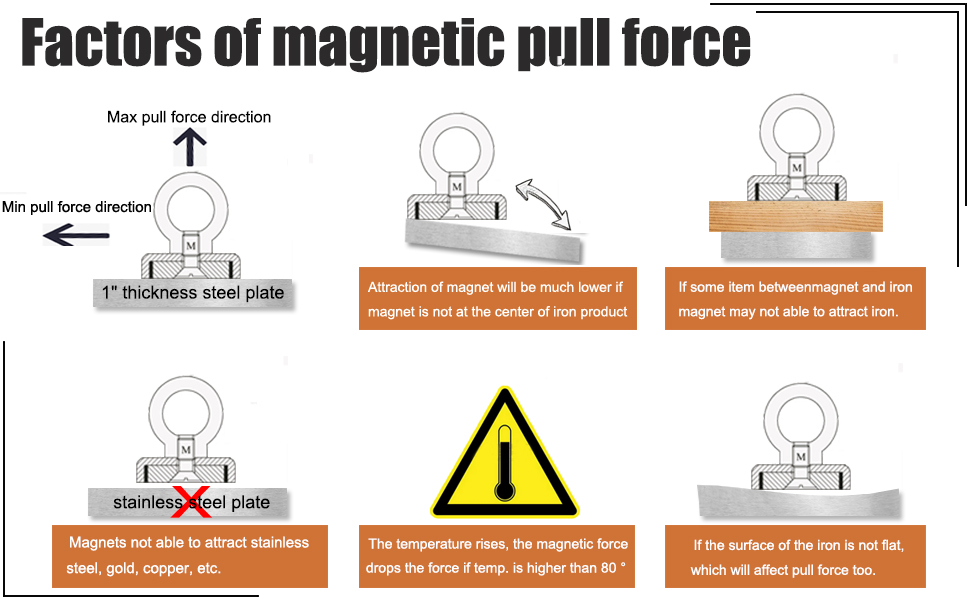
Why rated pulling force is not real holding force
Rated pulling force is measured when:
-
the magnet is attached to thick, flat steel,
-
the surface is clean and smooth,
-
force is applied vertically.
In real applications:
-
surfaces are uneven or painted,
-
shear forces are common,
-
vibration and movement occur.
➡️ This significantly reduces effective holding force.
Which neodymium magnet will hold 10 kg?
Recommendation:
-
magnet rated for at least 20–30 kg
Typical uses:
-
household mounts,
-
light metal fixtures,
-
adhesive-backed or housed magnets.
Which neodymium magnet will hold 20 kg?
Recommendation:
-
magnet rated for at least 40–60 kg
Typical uses:
-
tool holders,
-
workshop mounts,
-
medium-duty magnetic fixtures.
Which neodymium magnet will hold 50 kg?
Recommendation:
-
magnet rated for at least 100–150 kg
Typical uses:
-
magnetic fishing,
-
heavy-duty magnetic holders,
-
industrial mounting solutions.
Comparison table
| Actual load | Recommended magnet rating |
|---|---|
| 10 kg | 20–30 kg |
| 20 kg | 40–60 kg |
| 50 kg | 100–150 kg |
What else affects holding strength?
-
steel thickness and quality,
-
paint, rust, or coatings,
-
operating temperature,
-
direction of force,
-
use of a steel housing.
Each factor can significantly reduce holding power.
Common mistakes when choosing a magnet
-
selecting a magnet with no safety margin,
-
focusing only on grade (e.g. N52),
-
ignoring mounting conditions,
-
using bare magnets for heavy loads.
FAQ
Is N52 always stronger than N42?
Not necessarily – size, shape, and housing also matter.
Can a magnet suddenly lose its grip?
Yes, especially under shear force or vibration.
Does a steel housing increase magnet strength?
Yes – a properly designed housing can significantly improve effective holding force.