

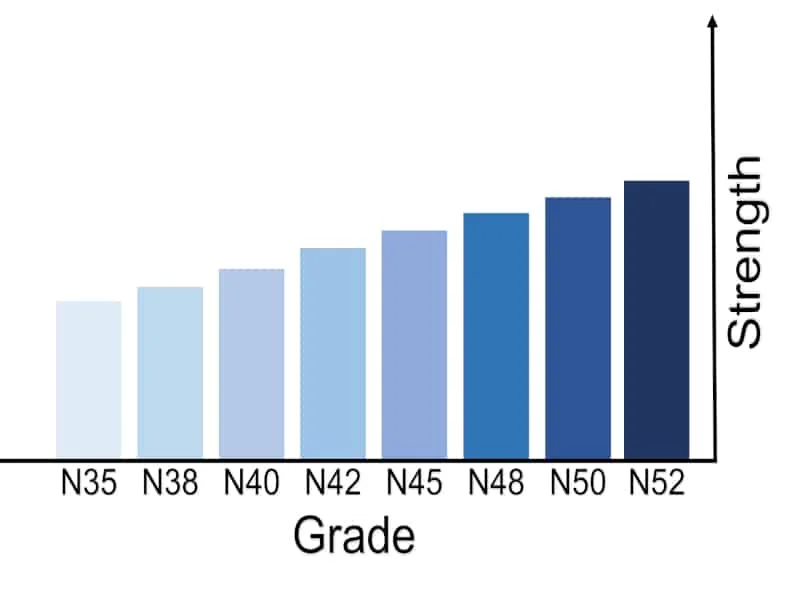
What do N42 and N52 mean?
The letter N refers to neodymium (NdFeB) magnets, while the number indicates:
-
maximum magnetic energy (BHmax),
-
the magnet’s potential strength.
Higher numbers mean:
-
higher magnetic performance,
-
higher cost and sensitivity.
N42 vs N52 – technical comparison
| Feature | N42 | N52 |
|---|---|---|
| Magnetic strength | high | very high |
| Strength difference | – | +20–25% |
| Temperature resistance | standard | standard |
| Cost | lower | higher |
| Typical uses | general-purpose | compact, high-force |
Practical differences you will notice
1. Holding force
An N52 magnet of the same size:
-
grips more strongly,
-
attracts metal more easily,
-
performs better with small air gaps.
2. Magnet size
For the same holding force:
-
N52 can be smaller,
-
N42 must be larger.
3. Operating temperature
Both N42 and N52 typically operate up to about 80°C.
Higher temperature resistance depends on grades like H, SH, or UH – not on N42 vs N52.
When should you choose N42?
Choose N42 if:
-
space is not limited,
-
extreme strength is unnecessary,
-
cost-efficiency matters,
-
conditions are stable.
When should you choose N52?
Choose N52 if:
-
space is limited,
-
maximum strength in a small size is required,
-
surfaces are uneven or coated,
-
magnets are used for fishing or heavy-duty holders.
Common mistakes when choosing N42 or N52
-
assuming N52 is always better,
-
ignoring housing and air gap effects,
-
confusing magnet grade with temperature class,
-
selecting magnets without safety margins.
FAQ
Is N52 always 52% stronger than N42?
No. The real difference is usually around 20–25%.
Does N52 lose strength faster?
No, as long as it is used within proper temperature limits.
Is N42 sufficient for most household uses?
Yes, in most cases N42 provides more than enough strength.